Gene leaves apes
speechlessGreat apes lack
nuts and bolts of language gene.
15 August 2002
HELEN
PEARSON
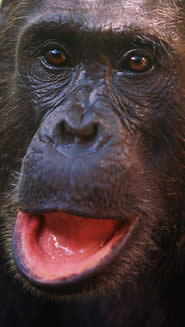 |
| Chimps lack fine control
of their mouth movements. |
| ©
GettyImages | | |
Chimpanzees lack key parts of a language gene that is
critical for human speech, say researchers. The finding
may begin to explain why only humans use spoken
language.
Last year scientists identified the first gene,
called FOXP2, linked to human language. People
with mistakes in this gene have severe difficulties with
speech and grammar1.
Now Svante Pääbo of the Max Planck Institute for
Evolutionary Anthropology in Leipzig, Germany, and his
colleagues have compared human FOXP2 with the
versions of the gene found in the chimpanzee, gorilla,
orang-utan, rhesus macaque and mouse.
Human FOXP2 contains two key changes in its
DNA compared with the other animals, the team
found2.
"It changed in the human lineage," says team member
Wolfgang Enard.
The changes may affect the human ability to make fine
movements of the mouth and larynx, and thus to develop
spoken language, Enard suggests.
"It's fascinating," says Martin Nowak, who studies
the evolution of language at the Institute for Advanced
Study in Princeton. "It's the beginning of a genetic
foundation for human language."
Language is unique to humans: chimpanzees can be
trained to communicate using a complex set of symbols,
but they can pronounce only a handful of words because
they cannot make the required facial movements.
The gene variant that permits language may have
become widespread during the last 200,000 years, Enard
estimates, based on analyses of the human gene from
individuals worldwide.
It was around this time that anatomically modern
humans emerged. The development of language may have
been an important driving force behind human expansion.
It allowed large amounts of information to be passed
from one generation to the next, explains Nowak.
Researchers are not yet clear what the FOXP2
gene does, but they think it acts by switching other
genes on and off. The two changes aside, the gene is
almost identical in humans and the other animals
examined. |